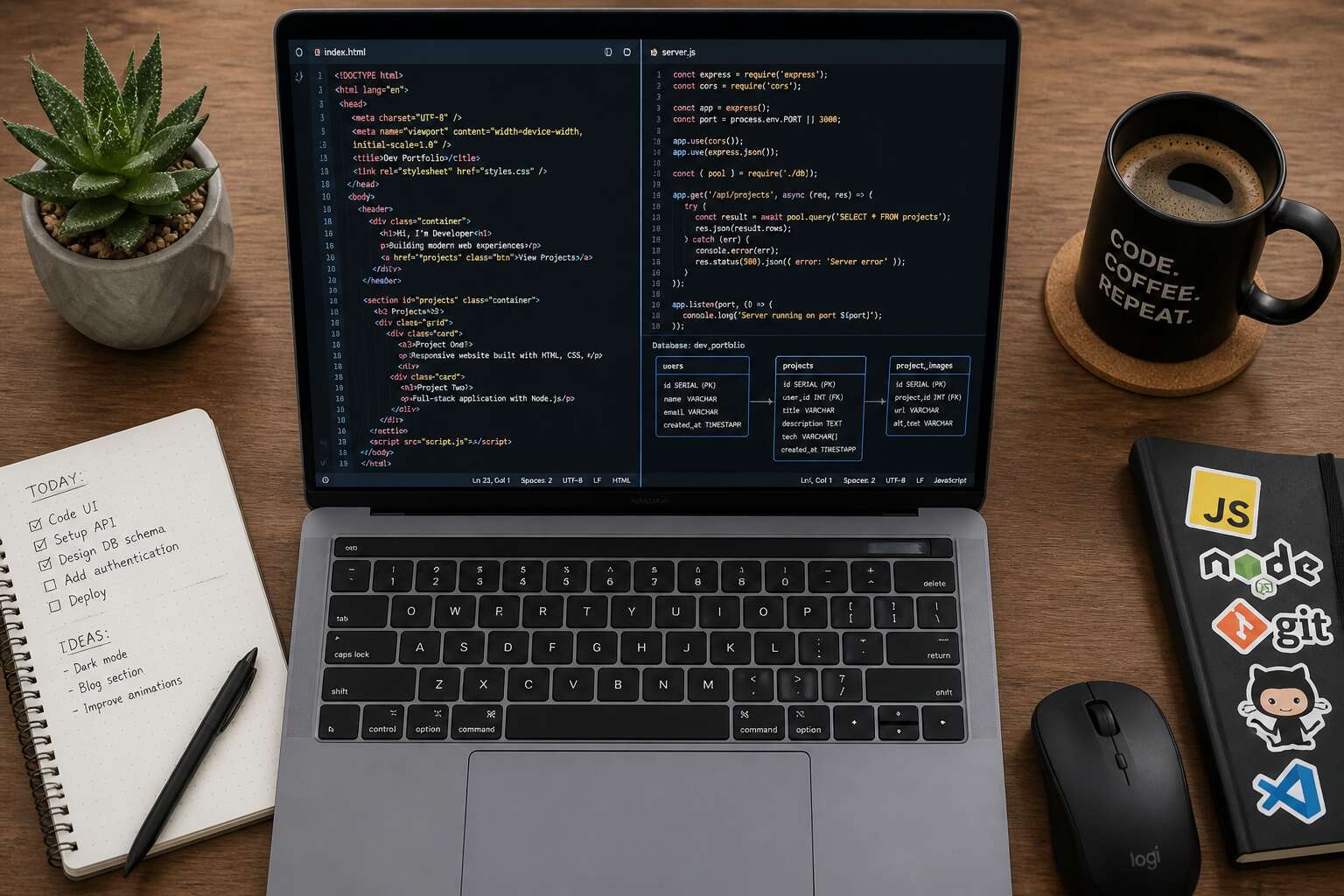
The Core Daily Activities of a Full Stack Developer
Designing and Implementing User Interfaces
What does a full stack developer do when the workday begins? For most, the first task is making sense of design files. Designing and implementing user interfaces occupies a significant portion of daily effort, transforming static mockups into responsive web pages that work on any screen size.
A typical morning might include:
- Converting wireframes into semantic HTML and CSS
- Adjusting layout spacing for mobile breakpoints
- Writing JavaScript logic for interactive elements
- Testing accessibility across assistive technologies
Later, the pattern shifts. What does a full stack developer do once the interface is built? They test, refine, and rebuild. South African users on limited bandwidth expect pages to load fast and respond instantly. Meeting that expectation requires disciplined front-end practice, repeated daily until users move through the page without thinking about it.
Building Robust Server-Side Logic
When the morning’s front-end work wraps up, attention moves to the server room. What does a full stack developer do with the rest of the day? They configure databases, design APIs, and enforce business rules that decide whether the product holds up under traffic. Server-side logic means handling authentication flows, rate limiting, and data validation before a single request reaches the user’s screen.
South African businesses expect digital products to survive load-shedding traffic surges. What does a full stack developer do to meet that expectation? They craft back-end systems that scale and degrade gracefully!
A typical afternoon might involve:
- Writing SQL queries that survive indexing flaws
- Designing REST endpoints that fail gracefully
- Orchestrating background jobs for payment reconciliation
- Securing sensitive user data with proper encryption layers
Server-side work rarely makes headlines, but without it, the most polished interface collapses. I have watched front-ends fail because of weak server logic.
Managing Databases and Data Flow
What does a full stack developer do once the interfaces are live and the server logic is set? They turn their attention to the data itself. Every click, transaction, and session generates a trail that must be captured, cleaned, and stored correctly. Data flow determines whether the product holds together!
Database management requires precision. Designing schemas that resist corruption, planning migrations without downtime, and ensuring data moves between systems without loss take up most of the afternoon.
A typical day of data stewardship includes:
– Monitoring query performance for bottlenecks
– Planning database migrations without downtime
– Setting up replication for disaster recovery
South African teams face unpredictable connectivity. Data pipelines must queue and retry automatically. What does a full stack developer do when a connection drops? They build those safeguards so the product survives.
Integrating Third-Party APIs and Services
The quiet hours between deployments hold their own dread. A full stack developer do battle with the unknown every day. Third-party APIs arrive with their own failure modes, their own silent refusals. Each integration is a contract signed in the dark.
The daily activity centres on summoning external services and binding them to our own systems. Payment gateways, mapping services, weather feeds. Each one demands attention! The developer listens for malformed responses.
- Mapping authentication flows across multiple providers
- Building fallback strategies for when a service goes silent
- Testing retry logic against rate limits and timeouts
We weave these dependencies into the product’s core. When a service fails, the product must not crumble. That is what a full stack developer do every day, chasing the threads that connect our code to the wider world.
Running Tests and Debugging Across the Stack
What does a full stack developer do when the test suite turns red? The morning starts with a failing test, and the hunt begins. Errors rarely announce themselves. They hide in edge cases, in unexpected user behaviour, in the spaces between services.
- Reproducing intermittent failures before they reach production
- Inspecting logs across multiple environments
- Writing regression tests to lock down fixes
Debugging demands patience. The developer isolates variables, questions assumptions, and reads stack traces like a local newspaper. Each fix carries the weight of the next deployment.
Essential Technical Skills and Tools
Front-End Framework Proficiency
A 2024 industry survey found that 78% of front-end rewrites occur because a colleague discovered a new framework on a Friday. The full stack developer do the real work by mastering the underlying principles, not the weekly trend. React, Vue, and Angular all share similar component logic and state patterns.
South African developers must weigh data costs and device capabilities. A beautiful app that requires 5MB of JavaScript will not charm a user on a prepaid network. Efficient rendering and lazy loading keep your project humane. Every extra dependency is a small betrayal.
Back-End Languages and Runtimes
South African back-end decisions are a matter of survival, not preference. A full stack developer do well to measure runtimes against real network costs. Node.js offers non-blocking I/O that suits chatty mobile APIs, while Go delivers raw concurrency for high-traffic services. Python remains a reliable workhorse for data-heavy operations. Each choice affects response size and server expense, and those factors ripple directly to a user’s prepaid balance.
For quick sanity, weigh these runtime traits:
- Cold start time under 200ms for slow connections
- Memory usage below 50MB per active instance
- Native JSON handling to avoid unnecessary parsing layers
These constraints shape what a full stack developer do when comparing Deno, Bun, or conventional servers. The runtime is the first mile of every request. A bloated environment burns data before a byte reaches the screen. Pick tools that respect bandwidth, because the code is only as trustworthy as its delivery.
Database Systems and Query Optimization
South African data costs shadow every decision a developer makes. The full stack developer do well to treat query optimisation as a survival skill. Every index, every execution plan, every avoided join alters what a user pays on a prepaid connection.
Profiling tools reveal slow scans and redundant reads buried in production logs. Relational systems enforce transactional consistency, while document stores trade that for schema flexibility. Both demand disciplined index design and selective column retrieval. A compact result set travels faster across a shaky network and weighs less on a metered bill.
Version Control and CI/CD Pipelines
Version control keeps every serious codebase coherent. A full stack developer do well to master Git beyond the basics, including rebasing, cherry-picking, and resolving gnarly merge conflicts. That skill alone turns chaotic collaboration into orderly progress.
CI/CD pipelines extend that discipline. Each push triggers automated builds and deployments, catching integration failures early and releasing software reliably. In South Africa, where bandwidth is metered, these pipelines reduce waste by preventing unnecessary manual downloads and repeated builds.
I find that a solid pipeline setup includes:
- A clear branching strategy that matches team workflow
- Automated tests that run on every commit
- Atomic deployments with instant rollback paths
- Environment parity across staging and production
These elements turn deployment from a nervous event into a predictable routine.
Cloud Platforms and Containerization
Cloud platforms are no longer optional infrastructure. They define how modern software gets built and shipped. AWS, Azure, and Google Cloud dominate the market, and South African companies increasingly expect their teams to operate in these environments. A full stack developer do well to understand that the cloud is more than a hosting service.
Containerization brings precision to that work. Docker packages an application with its dependencies, so it runs identically on a laptop or a production cluster. Kubernetes orchestrates those containers, handling scaling, load balancing, and self-healing. A full stack developer do well to master these tools early, as they shape every deployment decision.
A practical cloud setup includes:
- Managed databases to skip manual backups
- Object storage for static assets
- Serverless functions for occasional compute
- Infrastructure as code tools like Terraform
These choices lower monthly costs and free up time for feature work. I have watched teams cut release effort in half with containers!
Understanding Web Security and Authentication
Breach incidents in South African organisations have risen steadily across the past three reporting years, yet many developers still treat authentication as a login form and nothing more. A full stack developer do well to study OWASP’s Top 10 and internalize how each vulnerability appears in real code. SQL injection, cross-site scripting, and broken access control still dominate breach reports.
Authentication is a discipline, not a feature. JWT tokens expire for good reason. OAuth flows fail when redirects are mishandled. Session fixation attacks target lazy cookie configuration. I once audited a system where the password reset endpoint leaked user enumeration data, a simple flaw with severe consequences. Under POPIA, South African developers carry legal weight for these failures.
A robust security checklist includes:
- Hashing passwords with Argon2 or bcrypt
- Enforcing rate limits on auth endpoints
- Applying the principle of least privilege with role based access control
These fundamentals keep client data protected without slowing down delivery.
Collaboration and Communication Responsibilities
Working Closely with UI/UX Designers
Teams in Johannesburg know exactly what a full stack developer do when the design files arrive: they turn a UI/UX designer’s blueprint into a working interface without losing the intent. That means asking sharp questions about hover states, empty screens, and motion budgets before any code is written.
Communication responsibilities on a collaborative project include:
- Challenging design assumptions with real browser constraints
- Building a shared vocabulary for spacing and components
- Looping designers into technical decisions early, not after
This constant exchange prevents the classic fracture where designers blame developers for a flat product. Instead, the full stack developer act as the keeper of the user’s journey, ensuring every visual choice has a functional reason.
Coordinating with Product Managers on Roadmaps
Roadmaps are promises with dates attached. When a product manager in Johannesburg maps out a quarter, the full stack developer do the quiet work of turning those promises into achievable milestones. That means flagging technical debt early, estimating honestly, and resisting the urge to overcommit.
Coordination rituals matter more than grand gestures. Weekly backlog grooming sessions, clear definitions of done, and a shared understanding of what “urgent” actually means keep the team honest.
- Translating business priorities into technical sequencing
- Alerting PMs to legacy constraints before scope is locked
- Negotiating scope cuts when timelines slip
This is where trust gets built. When a full stack developer do this consistently, the roadmap stops being a list of hopeful desires and becomes a plan everyone can defend.
Participating in Code Reviews and Pair Programming
A single code review can save a week of debugging. The full stack developer do their deepest collaborative work in these moments. Reviewing code is not a formality. It is where assumptions get challenged and defects get caught early.
Good reviewers separate ego from the codebase. They ask questions instead of issuing verdicts. Pair programming takes this further. Two developers sharing one screen force continuous communication. The senior explains, the junior questions, both walk away with better context.
- Review the diff, not the author
- Ask clarifying questions early
- Ship small changes often
Thirty focused minutes beat three distracted hours! This is what full stack developer do when they treat collaboration as a discipline. The code improves. The trust compounds. The roadmap gets easier to defend.
Communicating Technical Trade-offs to Non-Technical Stakeholders
“Can’t we just add a button?” A non technical stakeholder once asked me this while staring at a two month roadmap. The full stack developer do their most underrated work in this exact moment, translating trade offs without condescension or capitulation.
The key is to show consequences in business terms. Explain that a faster rollout means accepting manual testing, or that a new feature delays the security audit. Present the choice plainly.
- The cost of speed
- The cost of caution
- The cost of silence
When the trade off is explicit, stakeholders trust the recommendation. That trust keeps the project moving and the codebase honest.
Mentoring and Supporting Junior Developers
People often ask what a full stack developer do when they are not shipping features. Much of that time goes to mentoring. Supporting a junior developer means explaining the reasoning behind a design choice, then letting them code it themselves.
Clear communication is the core of this work. We do not gain anything by making things sound complicated. Instead, we break down concepts like asynchronous callbacks or database indexing into plain language.
Mentoring also shows up in small actions:
- Pairing on a tricky deployment without taking over the keyboard.
- Recommending tools that help a junior debug faster.
- Asking open ended questions that lead to a solution.
This steady guidance creates a team where skill transfers naturally.
Strategic Impact on Project Success
Owning Features End-to-End from Concept to Deployment
A full stack developer do hinges on a quiet but profound responsibility: seeing a feature through from a fleeting idea to a living, breathing part of a product. This end to end ownership is where their strategic impact truly materialises. When one person understands the entire journey, decisions become coherent. The trade offs between a slick front end and a crunching database load are weighed with context, not guesswork.
This continuity transforms project success. Hand offs become hand shakes, and the friction of miscommunication simply evaporates. For a business, this means a feature built with an intrinsic understanding of its purpose, not just its technical specs. It is a force multiplier for any team.
– Reduces time to market by eliminating redundant briefings.
– Ensures technical choices serve the user story, not the other way around.
– Builds a natural bridge between business goals and code execution.
That holistic view is the unique value a full stack developer do brings to the table. It is the difference between assembling parts and nurturing a system. This ownership also spans the final, critical steps of deployment and monitoring. The developer who writes the code and lights the fire is the first to see how it burns in the real world, making the entire loop faster and more resilient.
Accelerating Rapid Prototyping and MVP Launches
Research shows that South African startups spend nearly four months on a first prototype. A full stack developer do can collapse that window to a few weeks, and that shift changes how a business learns from its users.
When one person owns the interface, the server, and the data flow, decisions happen in minutes instead of meetings. I have seen a team redirect a whole product strategy after a developer spotted a payment issue during a morning build. That speed is a concrete strategic advantage.
- Prototypes reach real users in days, not quarters.
- Failed ideas cost far less when they fail fast.
Speed is not a luxury in competitive markets. A full stack developer do turns speed into a repeatable process, and that process decides which features survive contact with customers.
Reducing Handoff Friction and Development Bottlenecks
The hidden cost of a project is rarely in the code itself. It lives in the silence between a designer’s handoff and a developer’s first question, in the days lost to clarifying a vague ticket. A full stack developer do eliminates that gap by owning the entire terrain, which means the handoff friction is erased because there is no handoff.
This consolidation is not about working faster under pressure. It is about acknowledging that context switching is the enemy of deep work. When a product manager describes a feature, the full stack developer do has already simulated the database query and the component state change in their mind. They do not need to translate the requirement into a formal spec, because they are the living spec.
Bottlenecks emerge when teams rely on a single specialist to process every change. The knowledge sits in a silo, and progress halts whenever that person is unavailable. Consider the specific points where momentum usually dies:
– The API response shape changes, which invalidates the frontend model.
– A database migration fails silently in staging, and no one knows who is accountable for the rollback.
– The authentication flow works on localhost but breaks behind the corporate proxy.
A full stack developer do neutralizes these failure points because the same person who wrote the SQL is the same person who adjusted the button state. The decision loop is internal, not relational. This does not mean the workload is lighter; it means the workload is continuous and uninterrupted. The delivery pace becomes reliable, and the strategic benefit is a predictable cadence that the business can plan around. That reliability, more than raw speed, is what transforms a launch timeline from a gamble into a commitment.
Ensuring Scalability and Performance Optimization
Strategic Impact on Project Success and Ensuring Scalability and Performance Optimization
A full stack developer do shapes a project’s outcome through every architectural decision. Scalability lives in the choices made during the first sprint, not in a final tuning pass. The database schema accounts for future load, the API boundaries remain flexible, and the frontend stays resilient to change.
Performance optimization follows the same pattern. When one person writes the query and measures the response time, bottlenecks get resolved before they reach production. The full stack developer do holds the complete view:
- Query execution plans reviewed against growing datasets
- Caching strategies applied at the application edge
- Bundle sizes monitored with every frontend change
- Infrastructure costs tracked alongside feature velocity
This unified view turns project success into a predictable outcome. The business receives a product that performs under pressure, and the team avoids the disruption of late-stage performance surprises.
Adapting Quickly to Shifting Business Requirements
Business requirements shift without warning. The full stack developer do sees the entire system at once, so they can estimate the true cost of a pivot in hours, not weeks. That estimate changes how the product manager prioritises the backlog. It changes whether the team builds a new module or modifies an existing one.
Consider a retail client in Johannesburg whose checkout flow suddenly needs lay-by payments. The full stack developer do recognises the database impact, the API adjustments, and the frontend state changes in a single pass. This holistic view means the pivot happens in days, not sprints.
The developer also spots which existing services can be reused, which assumptions no longer hold, and which technical debt will slow the change down. That clarity gives the business room to respond to market pressure without exhausting the engineering team.
Improving Code Maintainability and Documentation
A full stack developer do more than ship features. Their strategic impact shows in how they shape the codebase for the next person who touches it. When a developer owns the whole stack, they see which modules will rot first under changing conditions. They write documentation that explains why a service exists and what it does. This clarity reduces debugging time and keeps the team moving.
Consider a team that inherits a legacy payment system. A full stack developer do the painful work of mapping data flows and capturing edge cases. They leave behind clear API notes and a runbook for the CI/CD pipeline. That documentation becomes a shield against tribal knowledge.
- A short onboarding guide for new developers
- A decision log for why certain libraries were chosen
- A list of known technical debt and its impact
These artefacts turn maintainability from a buzzword into a practical standard. The result is a project that survives staff changes and shifting priorities without losing momentum.




0 Comments