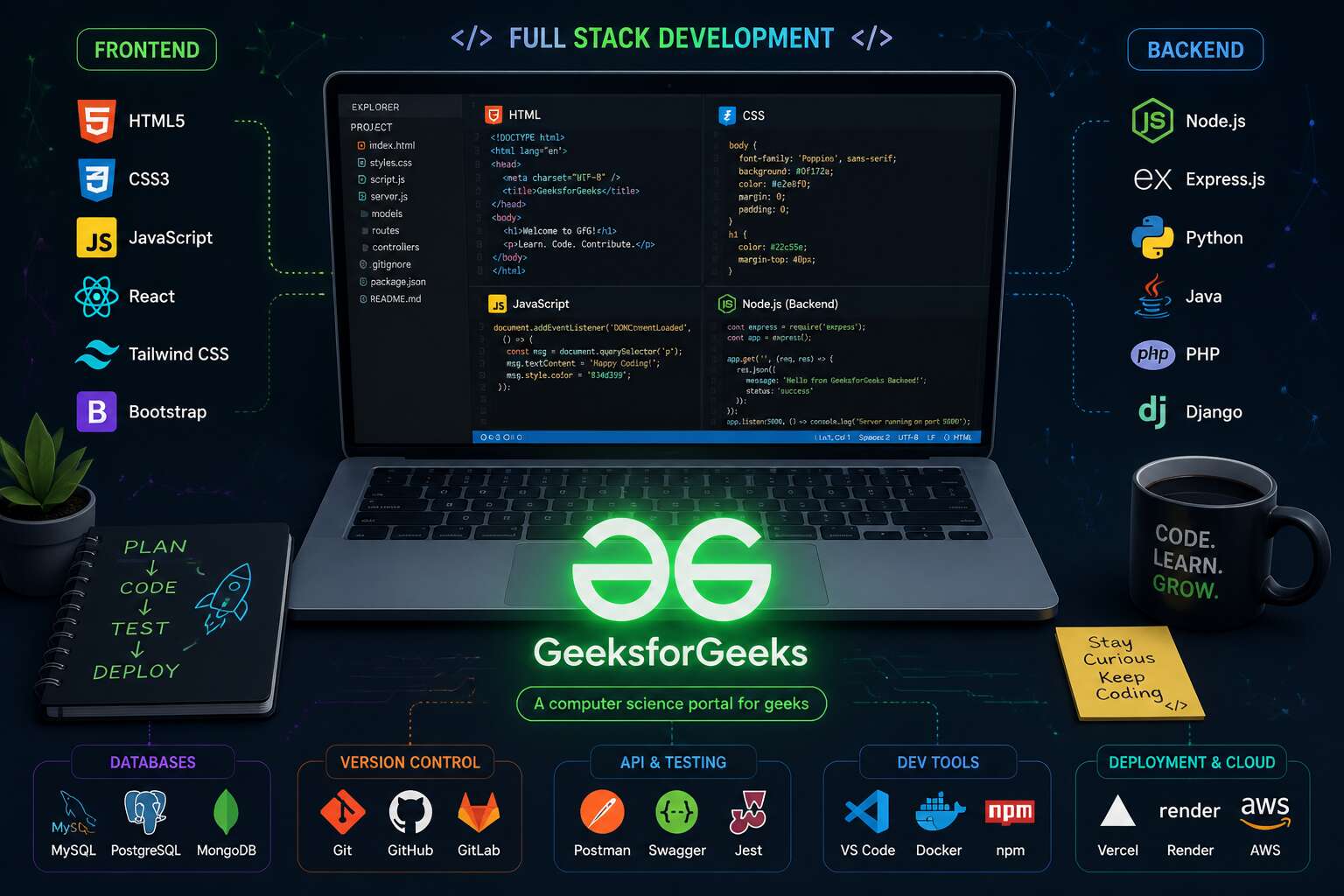
Understanding the Full Stack Developer Role
Defining the Full Stack Developer
The typical definition of a full stack developer gfg involves equal comfort with server side logic and client side presentation. In South Africa, this role has grown beyond simple coding proficiency into a matter of architectural ownership.
Understanding this position requires looking at the three core layers of any application:
- the frontend, where users interact;
- the backend, which processes requests;
- the database, which persists state.
A full stack developer gfg must traverse these layers without losing context. They deploy code, optimise queries, and design responsive interfaces within the same sprint. Their value lies in reducing handoffs between specialists.
Core Responsibilities Across the Stack
While definitions are helpful, they only paint half the picture. The real measure of a full stack developer gfg lies in the daily execution across the entire technical spectrum. This is where the role transforms from a title into a tangible set of responsibilities that directly impact the product lifecycle and the team’s velocity.
The core duties can be broken down into three primary action areas:
1. Architectural Bridge: Translating business requirements into a coherent technical structure that spans the UI, the server logic, and the data model.
2. Operational Ownership: Taking responsibility for the deployment pipeline, monitoring application health, and troubleshooting issues that arise in the production environment.
3. Contextual Continuity: Maintaining a clear mental map of how a user action flows through the database and back to the interface, ensuring no data is lost or misinterpreted along the way.
It is this last point, the contextual continuity, that separates a true full stack developer gfg from a specialist who merely dabbles. You are the custodian of the “glue code” that connects disparate systems. When a feature fails, you do not just fix the frontend bug or the backend error; you trace the fault line where they intersect. This unique vantage point allows you to anticipate integration problems before they surface, saving the team from painful debugging sessions. It is a role defined by breadth, but it demands a deep respect for the specific constraints and quirks of every layer you manage.
Must-Have Technical and Soft Skills
Mastery, in this context, is not a destination but a state of constant negotiation. The technical bar for a full stack developer gfg has shifted from merely knowing multiple languages to understanding how those languages constrain each other. The market in South Africa, with its unique mix of legacy enterprise systems and agile fintech startups, demands a developer who can navigate this friction without losing momentum.
Your technical arsenal must be practical and battle-tested. While the list of tools is endless, the foundational pillars remain surprisingly stable. You need to be fluent in the syntax of both the client and the server, but more critically, you must master the protocols that let them communicate. The real work often happens in the silence between the request and the response.
The core technical foundations you cannot negotiate on include:
- The ability to reason about database indexing and query performance from the outset, not as an afterthought.
- A solid grip on HTTP semantics, authentication flows, and how state is managed (or lost) across a distributed system.
- Familiarity with containerisation and the ability to debug an application that runs perfectly on your machine but fails in a Linux production container.
Yet, the technical stack is only half the equation for a full stack developer gfg. The soft skills are less visible but equally critical to your survival. The most significant of these is the humility to admit when you are outside your depth. Because you touch every layer, you will often be the first to spot a problem that belongs to a specialist’s domain. Your ability to communicate that finding clearly, without ego, accelerates the entire team.
I have seen developers stumble not on the code, but on the context switching. The ability to hold a complex UI interaction in your head while simultaneously debugging a race condition in a backend service is a cognitive muscle that requires deliberate training. This role is a constant exercise in prioritisation, often managing the unglamorous work like writing unit tests for legacy modules or documenting a data migration that will only run once. The work is not always novel, but it is always necessary. Ultimately, the question that defines your value is not what you can build, but what you can resolve when the build starts to break.
Common Job Titles and Career Paths
The job title itself can be a point of friction. One company’s full stack developer gfg is another’s glorified front end coder, and the title rarely tells the whole story. What actually defines the role is the scope of responsibility: the expectation that you can own a feature from database schema to UI polish without waiting for a handoff. In South African teams, this title often overlaps with “web developer” or “software engineer,” which makes salary benchmarks and job boards genuinely confusing. You will encounter titles like:
- JavaScript Full Stack Developer
- MEAN or MERN Stack Developer
- Product Engineer
- Solutions Architect (for senior roles)
The career trajectory is rarely a straight line. Many developers enter as front end specialists who gradually absorb backend duties out of necessity, while others start in backend systems and get pulled into interface work. The promotion path typically runs from junior to mid level, then to senior, where the focus shifts from writing code to mentoring juniors and making architectural decisions. A senior full stack developer gfg in Johannesburg or Cape Town often spends more time in planning meetings and code reviews than in the terminal, though the expectation to jump into production fires remains constant. Beyond that, the road splits. Some ascend into engineering management, others become technical leads, and a brave few move into DevOps or security. The terminal point of the role is a choice, not a ceiling.
Expected Salary and Market Demand
In South Africa, the market for a full stack developer gfg is a live negotiation. Companies in Johannesburg and Cape Town compete with remote hiring from Europe and the United Kingdom, which pushes local salary bands into strange territory. A mid level full stack developer gfg can earn between R250,000 and R380,000 annually, while senior roles in finance or logistics regularly exceed R600,000. The demand concentrates in fintech, where firms need engineers to own transactional systems, payment gateways, and client ports. That pressure on salary benchmarks comes from the scarcity of people who can debug a data pipeline and also reshape the user interface that exposes it. The recruitment trend reflects a backlog of roadmaps paused during the pandemic, so teams now look for one person to cover several critical gaps. The job boards in Cape Town show more full stack developer gfg listings than the city has active coders.
Essential Technologies and Tools
Front-End Languages and Frameworks
Every eighteen months, the JavaScript ecosystem produces a new framework. The underlying languages, HTML, CSS, and vanilla JavaScript, remain constant. A full stack developer gfg who ignores these fundamentals will face a rendering bug with no mental model of how the browser builds the page.
South African teams value engineers who understand the box model as deeply as they understand component props. The technologies below form the core toolkit.
- HTML5 semantic elements for structure and accessibility
- CSS Grid, Flexbox, and custom properties for responsive layouts
- Modern JavaScript with ES2023 features for interactivity
- TypeScript for catching type errors before deployment
Frameworks such as Next.js and SvelteKit add conveniences, but they compile down to the same browser primitives. Know those primitives, and the next framework release becomes less intimidating.
Back-End Languages and Runtime Environments
Back-end development in South Africa operates on strict performance budgets. Load-shedding schedules and variable network latency punish inefficient code. A full stack developer gfg must choose runtime environments with pragmatism, not loyalty to a trending language.
Node.js shares JavaScript syntax with the front end, which eases context switching. Python offers Django and FastAPI for rapid API construction. Go delivers exceptional throughput for high-traffic financial platforms in Johannesburg. Java remains entrenched in enterprise banking systems.
Runtime environments matter as much as language choice:
- Node uses the V8 engine for event-driven I/O
- Python relies on the GIL for single-threaded safety
- Go compiles to native binaries for low-latency microservices
A full stack developer gfg who understands these tradeoffs can predict performance bottlenecks before load testing begins. The language is a tool; the runtime is the operating context.
Database Management Systems
Database management systems demand the same pragmatism as runtime choices. A full stack developer gfg must balance consistency, availability, and partition tolerance against the reality of South African network conditions. Relational databases like PostgreSQL enforce strict transactions, which suits financial systems in Cape Town. NoSQL options like MongoDB offer flexible schemas for rapid iteration, but they shift complexity to the application layer.
Consider the operational burden. Load-shedding means unexpected shutdowns, so automatic recovery and durable writes matter more than exotic features. I have seen replication lag cause outages when the primary node sits far away. The database is an active participant in every request.
- PostgreSQL for transactional integrity
- MongoDB for document-oriented data
- Redis for caching and session state
Choose based on query patterns, not hype. A full stack developer gfg who understands indexing, sharding, and backup strategies can prevent outages before they happen.
Version Control and Collaboration Tools
Version control keeps every project honest. A full stack developer gfg relies on Git to track each change, from a single-line fix to a major refactor. Branching strategies like Git Flow keep feature work isolated, while pull requests create a checkpoint for code review. I have seen teams in Johannesburg lose hours to merge conflicts that a clear branching policy would have prevented.
Collaboration tools matter just as much. Distributed teams across South Africa need asynchronous communication that survives load-shedding. A well-structured repository with clear commit messages often matters more than the tool itself.
- GitHub for code hosting and pull requests
- GitLab for integrated CI/CD pipelines
- Slack for real-time team communication
- Jira for sprint planning and issue tracking
Choose tools that match your team’s workflow, not the loudest vendor. A full stack developer gfg who masters version control and collaboration can ship faster with fewer headaches.
Learning Path and Resources with GeeksforGeeks
Structured Online Courses and Tutorials
You could spend six months hopping between random tutorials, but that is a luxury your patience cannot afford. GeeksforGeeks structured online courses and tutorials offer a deliberate route. For the full stack developer gfg track, the platform sequences front-end logic, server handling, data persistence, and integration. The curriculum is ordered, so you avoid the classic mishmash of half learned tools.
A sensible learning path might look like this:
- Take a full stack starter course to survey the entire scope.
- Use topic specific tutorials to strengthen weak spots.
- Revisit the structured online courses before each practice project.
The full stack developer gfg resources pair each explanation with runnable code. You read, you type, you debug. That repetition converts theory into instinct. When you finish the final module, you have a portfolio of built features. The certificate is just a bonus.
Coding Practice and Problem Solving
The gap between watching a tutorial and owning the material is a chasm that only deliberate practice can bridge. For the full stack developer gfg journey, GeeksforGeeks coding practice and problem solving modules force you to apply the concepts you have just absorbed. You cannot simply observe these exercises. Each problem asks you to combine logic, syntax, and architectural thinking in ways that expose the limits of passive learning.
Practice problems on the platform tend to cluster around real friction points that developers face daily. A sensible list might include:
- Database query optimisation exercises that test your indexing intuition
- API request and response validation tasks where empty payloads break your assumptions
- Session management scenarios that require juggling state across multiple requests
Working through these patterns repeatedly, you begin to recognise common failure points before they arise. For the full stack developer gfg track, this practice is not optional. It is the mechanism that converts theoretical familiarity into reliable instinct. A developer who has wrestled with dozens of implementation bugs reads error messages with a different eye. They see the whole system, not just the offending line. That shift in perception is exactly what real project work demands.
System Design and Architecture Concepts
The leap from writing functional code to designing resilient systems is the true crucible for any full stack developer gfg candidate. GeeksforGeeks system design and architecture concepts provide the map for this territory. This is where you move past the syntax of a language and start considering the skeletal structure of an entire application. You learn to ask questions about data flow, failure points, and scaling constraints before writing a single line of code.
The resources guide you through layered architectures, where the separation of concerns dictates that a change in the database schema does not ripple through the front-end controllers. You examine the trade-offs between monolithic structures and microservices. Each module dissects how components communicate, whether through synchronous REST calls or asynchronous message queues. For the full stack developer gfg path, understanding these interactions is what separates an engineer from a coder. The material pushes you to diagram solutions, a practice that sharpens your diligence when you finally build the project.
Interview Preparation and Mock Tests
They say an interview is a conversation, but for a full stack developer gfg candidate, it often feels like a performance under a microscope. The gap between knowing a subject and articulating it under pressure is a chasm that many technical professionals fail to cross. GeeksforGeeks Interview Preparation is the bridge over that chasm. It does not simply present questions; it forces you to confront the gaps in your own reasoning. You might understand a sorting algorithm, but can you explain its space complexity when a senior engineer is staring through you? The material is dense, yet it mirrors the specific demands you will face.
The mock tests are where theory meets its ugly twin, anxiety. Sitting down to a timed test is a sobering experience. It is one thing to solve a problem while relaxed on your couch. It is another to do it when the clock is bleeding seconds away. The GeeksforGeeks mock environment replicates that tension with a startling degree of accuracy.
– Company-specific question sets
– Topic-wise breakdowns of your performance
– Difficulty curves that mimic real hiring screens
– Detailed editorial solutions after each attempt
You see your score, but more importantly, you see the patterns of your hesitation. This resource exposes the difference between what you know and what you can recall under duress. For the full stack developer gfg journey, this is the critical test. It is not about memorization; it is about resilience. By the time you finish, the real interview feels familiar, almost routine. You have already faced the pressure in a controlled setting, and that changes everything.
Building Real-World Projects
GeeksforGeeks isn’t a passive library. It functions as a structured roadmap for the full stack developer gfg journey, demanding you write code instead of just reading about it. The real challenge appears when you attempt their curated projects, where front-end React logic meets back-end Node.js APIs, often for the first time. This hands-on friction is where you build genuine resilience.
The platform excels at breaking complex concepts into digestible, action-oriented modules. By progressing through their recommended sequence, you move from basic syntax to deployment architecture without the typical tutorial limbo. A structured approach requires focusing on key areas:
- Data Structures and Algorithms for technical screening rounds.
- System design primers covering scalability and database choices.
- Full-stack project breakdowns that mimic production scenarios.
- Interview experiences from top tech firms to gauge real expectations.
These components transform abstract knowledge into practical skills. Consequently, when you finish a project, you possess a portfolio piece that proves your capability to manage an entire stack. That evidence, more than any certificate, becomes your strongest asset in competitive hiring landscapes.
Engaging with the Community and Forums
As you move beyond individual projects, the true shape of the full stack developer gfg journey begins to solidify. The process is rarely linear, and the path is often littered with debugging sessions that test your patience. To navigate this landscape effectively, you must treat the curriculum like a dynamic map rather than a static checklist. The structured learning path is a companion for this trek, offering a sequence that prevents you from getting lost in the endless sea of frameworks and libraries.
However, no map accounts for the unexpected roadblocks you will inevitably hit. This is where the pulse of the ecosystem becomes vital. Engaging with the community transforms a solitary struggle into a collaborative effort.
– You gain access to real-time conversations about emerging technologies.
– You find solutions to niche problems that standard documentation overlooks.
– You receive code reviews that highlight blind spots in your logic.
In this environment, a forum thread can be more valuable than a thousand lines of code. The shared experiences of fellow learners provide context that a tutorial cannot offer, filling the gaps between the official guides and the practical reality. It is this collective knowledge that often becomes the silent mentor for anyone charting their course to becoming a full stack developer gfg.
Building a Portfolio and Gaining Experience
Creating Personal Projects and Prototypes
A staggering 87% of hiring managers weigh a candidate’s portfolio more heavily than their degree. For any aspiring full stack developer gfg, this is the evidence that matters. It is the tangible proof of your ability to ship code, not just talk about it.
Your personal projects are your laboratory. They are where the abstract concepts from tutorials collide with the messy reality of broken builds and stubborn bugs. You will learn more from a failed deployment at 2 AM than from a perfectly executed course module. The key is to finish what you start. A half complete clone of a popular app is common. A polished, narrow tool that solves a single, real problem for a small group of users is rare and memorable.
Showcasing this work effectively is just as critical as the code itself. You need a professional presentation to make your efforts visible.
– Create a GitHub profile that is clean and organized, with detailed README files for each repository.
– Link to live, hosted versions of your projects so recruiters can interact with them without local setup.
– Include a dedicated projects page on a personal website to present the story behind each build.
– Write brief case studies that mention the challenges you faced and the specific technical decisions you made.
Do not wait until you feel “ready” to start building. Pick a small problem, such as a tool for your own workflow, and build it. Then iterate. The first version will be rough, but it will be yours. That raw, honest demonstration of your growth is what separates a candidate who learned from one who applies. It shows you possess the persistence required to be a successful full stack developer gfg, which is a skill no certification can prove.
Contributing to Open Source
Building a portfolio for a full stack developer gfg often starts with solo projects, but the real acceleration happens when you step into the collective arena of open source. This is where your code meets the scrutiny of strangers who care about quality. It is a stark departure from the safety of your own repository.
The experience gained here is multifaceted. You learn to read legacy code that is poorly documented, which is a skill in itself. You negotiate with maintainers about API design and test coverage. Your pull requests get rejected, and you learn to revise without taking it personally. This collaborative friction is where professional resilience is forged. It is a demanding classroom where the syllabus is written by real-world users and the grading is done by your peers.
A well-maintained contribution history also serves as a public ledger of your work ethic. It shows a full stack developer gfg can operate within a team setting, communicate clearly, and deliver on a schedule that is not your own. For a hiring manager in South Africa’s growing tech hubs, this evidence of collaboration often outweighs a flawless solo demo. The code you contribute becomes a reference point, a testament to your adaptability that lives far beyond your personal website.
Pursuing Internships and Freelance Work
In South Africa’s tight job market, I have watched portfolios open doors that CVs could not. Internships and freelance work force theoretical knowledge into professional instinct. A full stack developer gfg who survives a demanding client brief understands constraints no tutorial can simulate.
Internships offer structured exposure to production codebases, agile rituals, and the unglamorous labour of debugging legacy systems. Freelance projects leave you exposed. You own the timeline, the communication, and the result.
The durable skills are specific:
- Client communication and scope negotiation
- Navigating inherited code with unclear requirements
- Delivering under hard deadlines with real consequences
Each completed engagement for a full stack developer gfg becomes a case study in adaptability. Employers read these artefacts as evidence you can function where the work is messy and stakeholders are impatient.
Career Growth and Job Hunting Strategies
Crafting a Developer Resume and LinkedIn Profile
In the crowded field of full stack developer gfg, your resume is the first filter. South African hiring managers scan hundreds of profiles, so every line must show evidence of impact. I have seen skilled candidates overlooked because their achievements were hidden inside vague duty lists.
LinkedIn requires the same discipline. Your headline should name your core stack, not a generic title. The summary should present concrete projects and the numbers behind them.
- Use metrics for every role
- Name the specific technologies applied
- Include links to live work or repositories
Recruiters search using the same terms found in job descriptions; a precise profile will align with those queries.
Effective Networking and Referrals
Most South African tech roles never reach public job boards. Recruiters rely on internal referrals and quieter channels. That reality changes how a full stack developer gfg should approach job hunting and career growth. Your next move is built on who knows your work, not just what you post.
Effective networking looks like focused outreach to senior engineers. Attend local developer meetups in Johannesburg or Cape Town. Offer to review someone’s code and ask for feedback.
- Ask former colleagues for introductions, not favours.
- Share a small project you built, then ask what they would change.
- Follow up after a conversation with a concrete link or question.
Referrals work best when you make them effortless. A hiring manager values reliability and easy collaboration. Send a short summary of your recent build plus two lines about your interest. That gives your referees something specific to pass on.
Acing Technical and Behavioral Interviews
The panel across the table rarely expects perfection. They want to see how a full stack developer gfg reasons through a broken build, a vague requirement, and a tight deadline. South African interview loops lean on practical scenarios, so treat every question as a chance to expose your thinking.
Technical interviews reward clean code and clear speech. State your assumptions before typing. If you get stuck, say so and ask for a hint. Behavioural questions follow the same logic. I have watched strong coders fail because they froze under silence. They measure how you handled a missed deadline or a difficult client.
- Two stories about conflict at work.
- One story about a technical failure.
- One story about asking for help.
Career growth depends on your interview performance. A full stack developer gfg who treats preparation as a craft moves faster through the job market. Each attempt makes the next interview less mysterious.
Pursuing Certifications and Advanced Training
Certifications do not guarantee a job, but they do something useful: they make you searchable. South African recruiters often use applicant tracking systems that filter for specific credentials. A full stack developer gfg who holds a recognised certificate in cloud architecture or database management appears in more shortlists. That visibility matters when you are competing against hundreds of applicants.
Advanced training also pushes you past your comfort zone. I once ignored containerisation because my daily work did not require it. Then I took a certification course and realised how much time I wasted on manual deployments. The learning curve is steep, but the payoff is tangible.
When selecting courses, align them with your target industry:
- Fintech roles value security and payment certifications.
- Ecommerce companies look for performance and caching credentials.
- Government contracts often require compliance and data privacy training.
A full stack developer gfg who plans certifications strategically moves faster than one who collects random badges. Treat advanced training as part of your job hunt, not as an afterthought.
Staying Updated with Emerging Technologies
The tools that defined a full stack developer gfg five years ago are now legacy. Each quarter brings another runtime, another database model, another deployment strategy. Developers who advance their careers read release notes before they read job posts.
I track emerging technologies through a focused routine:
- Follow core maintainers on social platforms.
- Skim monthly changelogs for major frameworks.
- Build a tiny experiment with each new feature.
South African companies adopt new tech slowly, but they adopt it. When they do, they look for candidates who already understand it. Being the candidate who can speak to AI-assisted development or edge computing carries real weight. Staying updated needs to happen alongside the job hunt itself, woven into the same hours you spend refining your portfolio.




0 Comments