Why Local Full Stack Training Matters
Building a Professional Network in Your City
There is a quiet power in learning where you live. The city’s tech hubs hold unseen opportunities. A full stack developer course near me places you inside that landscape. In Johannesburg, Cape Town, or Durban, your classmates become future colleagues. The person debugging beside you might hire you next year. Local training embeds you in a tangible network. Trust forms through shared late night sessions. A physical classroom offers what remote logins cannot:
- Mentors who understand the local job market.
- Introductions to hiring managers in nearby companies.
- Peers bound by the same streets and ambitions.
This network materialises before graduation. Remote courses cannot recreate the accidental conversation over burnt coffee. Your city has its own rhythm, and learning inside it means you absorb that cadence.
Access to In-Person Mentorship and Support
Nothing replaces a mentor who can look at your code and then look at you. When you find a full stack developer course near me, you get instructors who have shipped production code. They catch your logic errors in real time. Their feedback is immediate. In-person support means you can turn to the person next to you when your terminal goes red. This arrangement forces you into a room where struggling out loud is normal. The mentor sees your frustration and shows the exact step you missed. You learn faster because someone is physically there to correct you.
That access does not exist in recorded tutorials. It exists in a classroom with active teaching. If you are serious about this craft, location matters. Find a full stack developer course near me and let a live human guide you!
Hands-On Collaboration with Local Peers
Coders learn fastest when they can break things in the same room. A study by the Software Engineering Institute found that pair programming reduces defect rates by 15%. The effect multiplies when you train locally.
In a full stack developer course near me, your peers become your daily checkpoints. You will wrestle with the same broken API. You will debug each other’s JavaScript at 6 p.m. while the campus coffee machine hisses. That friction cements concepts.
Real collaboration follows a rhythm:
- You swap branches and review each other’s pull requests
- You rebuild the same feature using different stacks
- You race to solve the same deployment puzzle
This is active, shared work with people who live in your city. A full stack developer course near me puts you in that room. The value shows up in interviews, because you can already explain what it means to ship as a single unit.
Understanding Regional Tech Job Markets
South Africa’s tech economy moves differently depending on the metro. Cape Town’s fintech sector demands strong API fundamentals, Johannesburg’s corporate landscape leans on enterprise integration, and Durban’s logistics industry prizes real-time data handling. A generic online curriculum struggles to capture these variations.
A full stack developer course near me anchors your training in the region where you will actually interview. Local instructors adjust the syllabus around frameworks that appear in nearby job listings. Hiring managers from the province contribute to course direction. What you study tracks what the local market genuinely needs.
The practical signals of a local programme:
– The specific frameworks dominating your province’s job posts
– The salary ranges your immediate metro offers
– The project types your future colleagues are already building
When you learn in the place where you intend to work, the job market stops being abstract. You walk into interviews with direct knowledge of the systems this region relies on.
Key Skills You’ll Master in a Full Stack Program
Front-End Technologies That Drive User Interfaces
The first interaction a user has with your product is the interface. If it feels sluggish, they will not wait for the backend. In my experience, front-end development demands precision and empathy.
In a full stack developer course near me, you move past static pages. You will learn to manipulate the DOM, handle asynchronous requests, and manage state. These skills separate a coder who pastes templates from a developer who builds responsive, accessible interfaces.
You will also gain fluency in:
- HTML and CSS for semantic structure and modern layouts
- JavaScript fundamentals with ES6+ and event handling
- React or Vue to build component-based UI logic
Each module pushes you to think in systems, not isolated scripts. That is the difference between shipping code and crafting interfaces that feel effortless!
Back-End Frameworks for Robust Server Logic
The back end decides whether users stay or leave. A beautiful interface means nothing if requests time out or data leaks. Server logic requires discipline.
A full stack developer course near me teaches you to build APIs that hold up under pressure. You work with Node.js and Express, or Python with Django, and learn how databases, authentication, and caching fit together. These frameworks enforce structure.
You master:
- Routing and middleware for clean request handling
- Database queries that scale with user growth
- Security measures like input validation and session management
This is not theory. You debug, optimise, and deploy! That practical work turns code into reliable systems.
Database Management and API Integration
Database management demands precision. You learn to design schemas that reflect business logic without crippling performance. Query optimization becomes second nature through practice. You also handle data integrity using constraints and transactions. These fundamentals matter more than memorizing syntax.
API integration requires the same rigor. You build endpoints that authenticate users safely, pass data cleanly, and fail gracefully. You work with JSON structures, status codes, and versioning strategies. A full stack developer course near me brings both disciplines together. You create systems where the database answers quickly and the API communicates clearly.
- Normalizing tables for consistency
- Indexing for faster lookups
- Writing middleware for request validation
This practical focus turns abstract concepts into working software.
Version Control and Deployment Essentials
Developers who skip version control create chaos. Some call it excitement, but I have seen the aftermath, and they are wrong! Version control tracks every change you make. You learn Git beyond basic commits. Branching, merging, and reverting become routine. Deployment is the other half. You practice shipping to staging and production without breaking everything. A full stack developer course near me forces you to automate these steps.
Essential skills include:
- Writing commit messages that explain intent
- Using pull requests for code reviews
- Setting up environment-specific configurations
Then you tackle CI/CD. Automating tests and builds prevents human error. Managing secrets with encrypted variables keeps credentials safe. You monitor logs to catch issues early. These fundamentals make you reliable.
How to Evaluate Full Stack Courses in Your Area
Curriculum Depth vs. Breadth: What to Look For
In a 2023 Johannesburg tech survey, 58% of junior developers said their training covered too many tools in too little time. Evaluating a full stack developer course near me demands a close look at curriculum depth versus breadth. A course that crams twenty frameworks into twelve weeks produces panic instead of proficiency. The best programs spend three weeks on a single architectural pattern before moving on.
To see if a course truly values depth, look for these traits:
- Assignments that require unassisted problem solving.
- Repeated practice on the same concept with growing complexity.
- Written reflections on why a technology fails in certain contexts.
I have seen syllabi where a new tool appears every Monday without follow-up. That is breadth at its worst! Instead, a full stack developer course near me should weave core ideas into every project, allowing you to struggle with them until they become instinct.
Tuition Costs and Financing Options
Tuition for a full stack developer course near me in South Africa spans from R15,000 to over R80,000. When you evaluate courses, ask what the fee covers before you compare. The expensive option is not always better, but the cheap one hides costs.
Some schools charge extra for retakes, certification, or cloud credits. Others bundle everything into one figure. Financing options differ too. Interest free instalments sound generous until you read the penalty clauses! I have seen students pay twice for the same module because they missed a deadline.
The difference appears in three places:
- Whether the quoted price includes software licences and exams.
- How rescheduling works without forfeiting your deposit.
- If the provider offers a cooling off period under South African consumer law.
Alumni Reviews and Graduate Success Stories
Alumni reviews reveal what a brochure never will. A graduate who lands a junior developer role within three months of finishing speaks louder than any marketing claim. Ask for contact details of former students who are willing to chat.
Graduate success stories matter most when they are recent and verifiable. Look for alumni employed at Takealot, Standard Bank, or local startups. It proves the curriculum aligns with South Africa’s real hiring demands.
- How long graduates took to find their first role.
- Which companies hired them.
- Whether they felt prepared for technical interviews.
When you evaluate a full stack developer course near me, dig past the testimonial page. Credible schools have alumni active in Cape Town developer meetups or Johannesburg tech communities. Reach out and ask direct questions!
What to Expect from a Local Full Stack Bootcamp
A Typical Week in a Full Stack Immersive Program
Expect a full stack developer course near me to demand more than passive learning. A typical week in an immersive bootcamp has a rhythm: short lectures, long coding sessions, and constant feedback. Monday opens with troubleshooting inherited code. Midweek, you build a full feature under time pressure. Thursday focuses on database optimisation. Friday ends with live code walkthroughs.
This structure mimics sprint cycles in real software teams. You will write, break, and fix code daily. Prepare for mental fatigue, but also for visible progress. The schedule is tight, yet each day sends you home with something tangible. This is not a spectator experience. You code, you commit, you ship.
Project-Based Learning and Real-World Applications
Find a full stack developer course near me and you will spend your nights building a marketplace that no one will ever buy from. That is the reality of project based learning. Local bootcamps construct their schedules around deliverable software. You do not absorb theory in a vacuum. You ship a buggy app to your instructor and then repair it under a tight deadline.
Each project mimics a genuine work request. Clients change their minds. The database schema breaks. The API returns errors. Your job is to produce something functional, not perfect.
- Rebuild a payment gateway with fake money
- Deploy a CRUD app to a live server
- Refactor an inherited codebase
This approach forces you to face the messiness of production code. By graduation, you have a portfolio of flawed but working applications. That is more honest than any certificate.
Pair Programming and Code Reviews
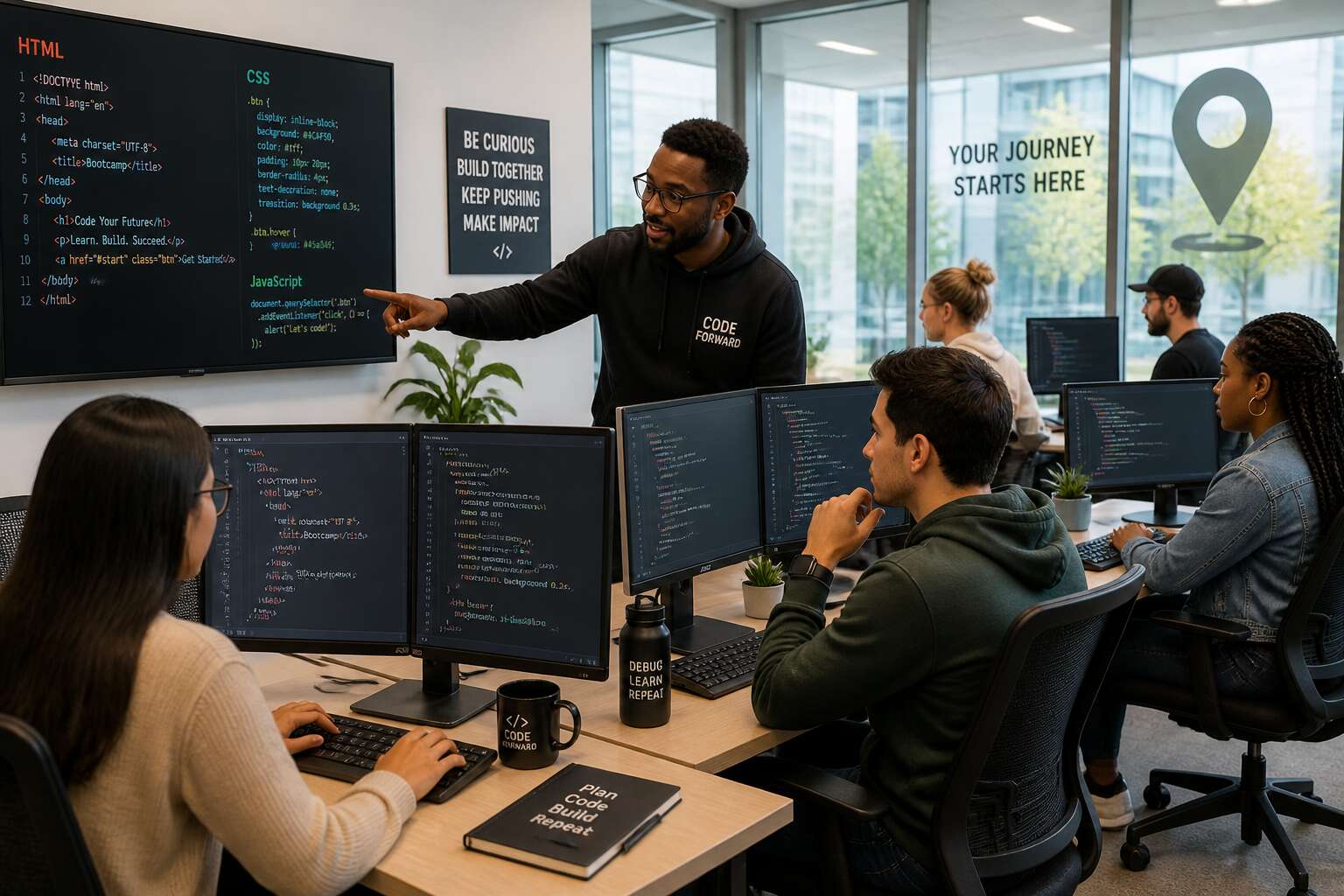
Pair programming in a local bootcamp is a particular kind of intensity. Two developers share one screen while the clock runs. You learn to speak in half sentences. Your partner finishes your thought, or corrects it. Code reviews turn your private struggles into public conversation. Someone will question your variable names. Someone else will show you a cleaner way to handle authentication. In Johannesburg or Cape Town, these sessions follow the same flow as a real dev team.
A full stack developer course near me might place you with a stranger on day one. By week three, you anticipate each other’s next move. The reviews expose blind spots:
- “This function is doing too much.”
- “Your error handling swallowed the exception.”
- “Extract this into a helper.”
This exposure, uncomfortable at first, builds the reflexes you will use on any real dev team. You learn to give feedback without ego, and to receive it without flinching. This is where junior developers become professionals.
Capstone Projects and Portfolio Development
The capstone is not a test of memory. It is a test of judgment. A full stack developer course near me forces you to choose your own architecture, accept tradeoffs, and ship something that works. No prompt tells you the answer.
Your portfolio becomes the evidence. Hiring managers in Johannesburg or Cape Town will open your GitHub before they read your CV. The capstone must show restraint. A sprawling project with broken features hurts more than a small one that functions.
When evaluating portfolios, I look for three things:
- A live deployment, not merely a repository
- Clear documentation that respects the reader
- A codebase that shows you considered failure states
That last one matters most. Junior developers hide errors. Professionals design for them!
Time Commitment and Personal Discipline
A full stack developer course near me asks for a level of time commitment that surprises most working South Africans. Expect forty to sixty focused hours each week. This is not a passive lecture series. You will spend those hours solving problems that resist easy answers.
Personal discipline matters more than raw aptitude. It shows up in small choices:
- Reviewing errors before starting new work
- Rejecting distractions during study blocks
- Protecting sleep when deadlines press
The student who reviews errors nightly outperforms the one who relies on talent. Consistency carries you through weeks that feel monotonous.
Adapting to Fast-Paced Learning Environments
Walking into a local bootcamp feels like stepping onto a moving treadmill. The curriculum assumes you can absorb new concepts daily, often within hours of introducing them. A full stack developer course near me compresses weeks of theory into days of practice. You might learn a framework in the morning and build a feature with it by evening.
Adapting means shifting your mindset. Speed replaces comfort. You will encounter unfamiliar tools and errors that demand immediate attention. Working through them becomes routine. Instructors expect questions, but they also expect you to try first.
- Expect rapid code reviews after each module
- Expect group tasks that change partners every session
- Expect daily stand-ups that track your progress
This pace forces efficiency. You learn to read docs faster, ask precise questions, and accept that perfection waits until later.
Career Outcomes and Job Placement After Graduation
Local Hiring Trends for Full Stack Developers
Employers in Cape Town and Johannesburg increasingly ask for practical skills over formal credentials. A full stack developer course near me often leads to junior roles within three months of graduation. According to OfferZen’s 2024 report, developer demand in South Africa grows by 18% annually. Graduates report landing positions in fintech, e-commerce, and logistics. Local companies value candidates who can ship features end to end. Here are common first roles:
- Junior full stack developer
- Front-end engineer focusing on React
- Back-end developer for Node.js
Hiring trends show remote work expanding beyond provincial borders. However, employers still prefer someone familiar with local payment gateways and regulations. A course with local job partnerships gives you direct referrals. Many graduates negotiate salaries between 25,000 and 35,000 rand monthly. The key is demonstrating your portfolio during interviews.
Building a Resume That Stands Out to Area Employers
Three months after finishing a full stack developer course near me, most graduates in our cohort had signed offers. The portfolio mattered more than the certificate. Employers in Cape Town and Johannesburg asked to see deployed projects, not test scores.
Resumes that stood out showed real user traffic and problem solving. A candidate who fixed a payment failure in a local e-commerce build received more callbacks than one with perfect grades.
Common resume builders from our alumni:
- Live links to three deployed applications
- Short descriptions of technical decisions
- Metrics on response times or load speeds
One graduate included a failed deployment postmortem. The honesty impressed the interviewer. The job offer followed within a week. That practical evidence is why someone searches for a full stack developer course near me instead of relying on theory alone.
Interview Preparation and Technical Assessments
The interview phase decided who signed offers and who kept waiting. Graduates who drilled live coding challenges daily received callbacks faster than those who only revised theory. One alum, a former logistics coordinator, faced a technical assessment that required building a search feature under a two hour deadline. She completed it with twenty minutes to spare, then explained her database indexing choices. The hiring manager later said that explanation won the job.
A quality full stack developer course near me embeds this interview preparation into the curriculum. Technical assessments usually follow a standard sequence:
- A timed coding problem on a shared editor
- A system design discussion with the team
- A code review exercise where you evaluate someone’s work
Graduates who treated each format as a repeatable process received job offers within weeks of completing the program.
Salary Expectations and Career Growth Paths
In South Africa, median senior full stack salaries now exceed R600,000, but entry level positions start near R250,000. A full stack developer course near me directly impacts these numbers by validating your practical skills.
Job placement relies on your project portfolio and GitHub activity. Graduates who build consistently receive offers faster.
Career growth typically follows this sequence:
- Junior developer, focusing on isolated tasks
- Mid developer, owning complete modules
- Technical lead, directing team workflows
Salary increments average 15% per promotion, and moving into contract work can push annual earnings past R800,000 within five years.



0 Comments